
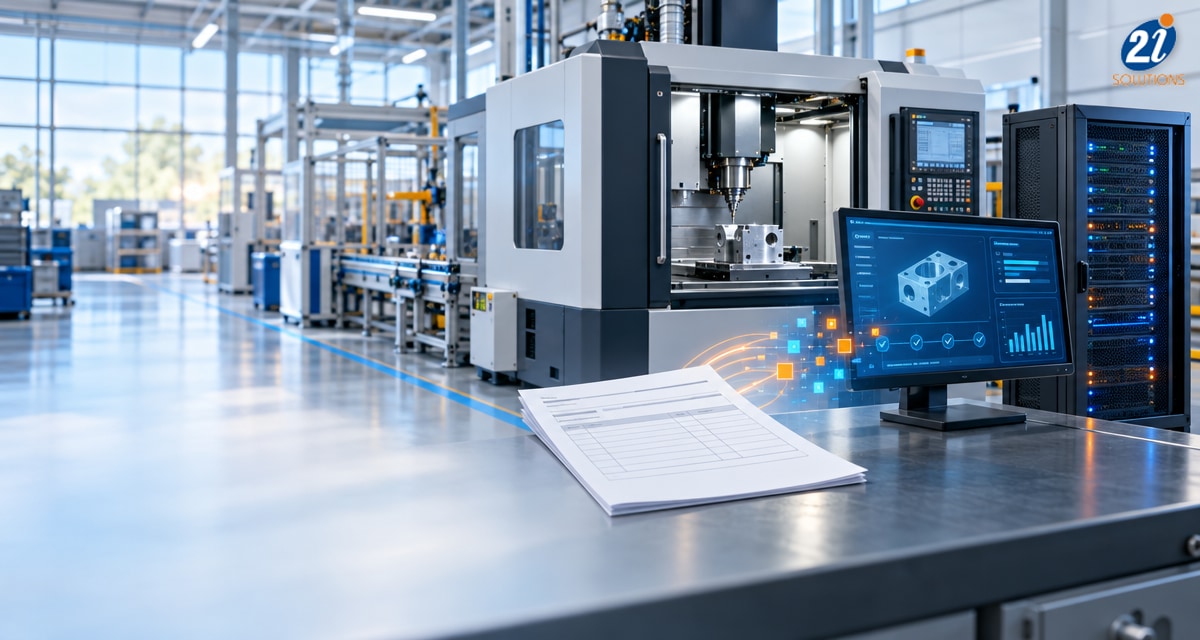
Most manufacturers running disconnected shop floor systems lose between 5% and 15% of production capacity to avoidable inefficiencies, according to IDC Manufacturing Insights. If your plant still relies on paper-based work orders, spreadsheet-driven scheduling, or siloed quality data, a SAP Manufacturing Execution System implementation may be the most impactful project your operations team takes on this decade.
This guide walks through what US manufacturers need to know before, during, and after an SAP MES rollout. Coverage includes the business case, the technical realities, and the decisions that determine whether your project delivers results on time and on budget.
What Is a SAP Manufacturing Execution System?
A SAP Manufacturing Execution System (MES) is a real-time software layer that connects your shop floor operations directly to your ERP backbone. Plant managers, quality teams, and supply chain leaders gain a single, live view of production through the system. It bridges the gap between planning systems and physical manufacturing, so every work order, quality check, and machine event is captured, tracked, and acted on in real time.
For US manufacturers, this matters because the gap between what ERP systems plan and what the shop floor actually produces is where margin disappears. An SAP MES closes that gap by digitizing production execution. It automates quality inspections and feeds real-time data back into SAP S/4HANA for accurate costing, scheduling, and reporting. Implementation partners like 2iSolutions have helped manufacturers across North America bridge this gap with proven deployment approaches.
Production order management, material tracking, quality management, machine integration, and operator guidance are all covered by the system. When it works well, it replaces clipboards, manual data entry, and end-of-shift reconciliation with live digital workflows that every stakeholder can see.
Why US Manufacturers Are Prioritizing MES Projects in 2026
Labor shortages, supply chain pressure, and customer demand for traceability are pushing manufacturers to act. According to Gartner, by 2026 more than 60% of large manufacturers will have deployed or actively piloted a digital shop floor solution as part of their broader Industry 4.0 strategy.
Consistent business drivers emerge across sectors. Customers want serialized traceability. Regulators want audit trails. Finance teams want accurate production costs without waiting for month-end closes. All of these needs point to the same answer: a connected, real-time manufacturing execution layer. Organizations working with experienced partners like 2iSolutions understand that the competitive advantage goes to manufacturers who move first.
Electronics and semiconductor plants face particular pressure in SAP High-Tech Manufacturing environments. Complex routing, tight tolerances, and rapid product changeovers characterize these operations. Without a proper MES, quality escapes and rework costs climb fast. Discrete manufacturers running high-mix, low-volume production face similar challenges where manual tracking simply cannot keep pace. SAP High-Tech Manufacturing solutions are specifically designed to handle these complexities. They include built-in support for advanced product configurations and rapid changeover management.
The Cost of Waiting
Every month without a connected shop floor is a month of lost data. You cannot improve what you cannot measure. Plants that delay MES projects often find that their ERP data is unreliable. Manual inputs that arrive late, incomplete, or incorrect form the foundation of this unreliability. That unreliable data then flows into planning, procurement, and finance, compounding the problem upstream. For manufacturers in SAP High-Tech Manufacturing sectors, this delay compounds even faster. Product genealogy and traceability requirements add complexity. Consulting firms like 2iSolutions emphasize that the cost of delay often exceeds the investment in rollout.
How SAP MES Integrates with S/4HANA
SAP Manufacturing Execution System connects to SAP S/4HANA through standard APIs and the SAP Digital Manufacturing Cloud. SAP defines this as its cloud-native MES platform built on SAP Business Technology Platform (BTP). BTP is SAP's integration and extension platform that allows organizations to connect, extend, and build applications across their SAP environment.
Production orders created in S/4HANA flow directly to the shop floor through this integration. Operators confirm completions, record scrap, and log quality results in real time. Those confirmations write back to S/4HANA immediately, so inventory, costing, and scheduling stay current without manual intervention.
For companies already on RISE with SAP, the path to SAP Digital Manufacturing Cloud is well-defined. Cloud deployment reduces infrastructure overhead. Manufacturers gain access to continuous updates without disruptive upgrade cycles.
On-Premise vs. Cloud MES: Which Fits Your Plant?
Some manufacturers, particularly those in regulated industries or with high-security requirements, prefer an on-premise SAP MES deployment. Others benefit from the cloud model, especially when they operate multiple plants and want a single centralized system. Your network architecture, your IT team's capacity, and your regulatory environment determine the right answer.
Both models integrate with S/4HANA. Both support the same core manufacturing execution functions. Deployment speed, total cost of ownership, and how updates are managed over time represent the key differences.
SAP Automotive Solutions and Industry-Specific MES Requirements
Automotive manufacturers face a distinct set of MES requirements. SAP Automotive Solutions address these directly. They include built-in support for just-in-time and just-in-sequence delivery, vehicle identification number (VIN) tracking, and supplier quality management. These are not generic manufacturing features adapted for automotive use. They are purpose-built capabilities designed around how automotive plants actually operate.
For Tier 1 and Tier 2 suppliers in the US, traceability is non-negotiable. OEM customers require full genealogy records for every component. An SAP MES with automotive-specific configuration captures that genealogy automatically. Raw material receipt through final assembly tracking occurs without requiring custom development. SAP Automotive Solutions extend this capability across the entire supply chain. Suppliers can meet OEM requirements while maintaining production efficiency.
Production data flows directly into quality management, warranty analysis, and supplier scorecards through the integration between SAP Automotive Solutions and the broader SAP ecosystem. End-to-end visibility separates a well-implemented SAP MES from a standalone shop floor system. Standalone systems create yet another data silo. Implementation partners with automotive expertise, such as 2iSolutions, understand these requirements deeply. They design MES configurations that support OEM compliance from day one.
What Enterprise Digital Solutions Mean for Your MES Project
A SAP MES implementation does not exist in isolation. One component of a broader set of Enterprise Digital Solutions, it connects your plant to your supply chain, your finance team, and your customers. Treating MES as a standalone project causes you to miss the compounding value that comes from integration. This broader connected-operations perspective is also reflected in guidance from Deloitte Insights on using digital transformation to connect technology investments with measurable business outcomes.
Enterprise Digital Solutions in a manufacturing context typically include the MES layer, ERP integration via S/4HANA, analytics through SAP Analytics Cloud or Power BI, IoT connectivity for machine data, and quality management systems. Manufacturers gain capabilities that no single system can deliver alone when these components work together. Advanced planning, supplier collaboration, and customer quality portals also fall within Enterprise Digital Solutions. Visibility extends beyond the plant floor through these additions.
For example, machine downtime captured by the MES feeds into SAP Analytics Cloud dashboards that operations managers review each morning. Quality defect trends identified in the MES trigger supplier corrective action requests in the procurement module. Production cost variances calculated in real time flow into financial reporting without waiting for period-end reconciliation.
Building a Connected Manufacturing Architecture
Architecture planning before rollout begins is key to realizing this value. Too many MES projects start with the shop floor and work outward. Integration gaps only emerge later in these cases. A better approach starts with the business outcomes you need. Map those to the data flows required and then design the MES configuration to support those flows from day one.
Experienced SAP consulting firms earn their value at this stage. Learning the technical configuration of an SAP MES is straightforward. Designing an integration architecture that scales across multiple plants requires deeper judgment. Future acquisitions must be supported and technical debt must be avoided.
Common Implementation Challenges and How to Avoid Them
SAP MES projects fail for predictable reasons. Understanding them in advance gives your team a significant advantage.
The most common challenges include:
- Master data quality: Production routing, work center definitions, and material master data must be clean before go-live. Dirty master data in an MES creates incorrect work orders, wrong material consumption, and unreliable quality records.
- Change management: Operators and supervisors who have worked with paper-based systems for years need structured training. They need clear communication about why the change is happening and what it means for their daily work.
- Integration testing: The connection between the MES and S/4HANA must be tested under realistic production volumes before go-live. Latency issues and data mapping errors that appear minor in testing become critical failures during a live production shift.
- Scope creep: MES projects attract feature requests from every department. A disciplined scope management process keeps the project on track and reserves enhancements for post-go-live phases.
- Network infrastructure: Real-time MES operation requires reliable plant floor networking. Wi-Fi dead zones, aging switches, and inadequate bandwidth are shop floor problems that become MES problems the moment you go live.
Addressing these challenges requires a project team with both SAP technical expertise and manufacturing operations knowledge. Consultants who understand only the software side often miss the operational realities that determine whether a go-live succeeds.
Frequently Asked Questions
Q. How long does a SAP Manufacturing Execution System implementation typically take?
A. A single-plant SAP MES implementation typically takes 6 to 12 months, depending on scope, integration complexity, and master data readiness. Multi-plant rollouts run longer, often 18 to 36 months for large manufacturers. 2iSolutions US has delivered MES projects across manufacturing sectors in the US. Master data quality at project start is the most reliable predictor of timeline.
Q. Do we need to be on SAP S/4HANA before implementing an SAP MES?
A. You do not need to be fully on S/4HANA before starting an MES project, but the integration is significantly cleaner when you are. Many manufacturers run parallel workstreams, migrating to S/4HANA while piloting MES at one plant. Validating the integration architecture before scaling becomes possible through this approach. Your implementation partner should map the sequencing based on your current ERP version and go-live targets.
Q. What is the difference between SAP Digital Manufacturing Cloud and the on-premise SAP MES?
A. SAP Digital Manufacturing Cloud is SAP's cloud-native MES platform, built on BTP and delivered as a subscription service with continuous updates. On-premise SAP MES (formerly SAP ME) runs on your own infrastructure and requires managed upgrade cycles. Faster deployment and lower infrastructure overhead favor the cloud option. Plants with strict data sovereignty requirements or limited cloud connectivity benefit more from on-premise solutions.
Q. How does SAP MES support quality and compliance requirements in regulated industries?
A. SAP MES captures quality inspection results, defect records, and corrective actions in real time. A complete audit trail supporting FDA, ISO, and automotive OEM compliance requirements is created through this capture. Electronic batch records, serialized traceability, and statistical process control are standard capabilities. 2iSolutions has implemented MES solutions for healthcare, pharma, and automotive manufacturers where compliance documentation is a primary project driver.
Q. What does an SAP MES implementation cost for a mid-size US manufacturer?
A. Total project cost for a mid-size US manufacturer typically ranges from $800,000 to $3 million. Software licensing or subscription, implementation services, infrastructure, and training are all included in this range. Scope, number of production lines, integration complexity, and change management requirements vary significantly, creating the wide range. A detailed scoping workshop with your implementation partner is the only reliable way to size the investment for your specific environment.
What to Expect When You Partner with an Experienced SAP MES Team
Choosing the right implementation partner is as important as choosing the right software. An experienced SAP consulting firm brings more than technical configuration skills. Operational realities of your plant are accounted for through its delivery approach. Change management approaches get operators on board before go-live. Integration expertise connects your MES to the broader SAP environment without creating new data silos.
2iSolutions has delivered SAP manufacturing solutions across high-tech, automotive, and discrete manufacturing environments in the US since 2007. Certified SAP expertise across MES, S/4HANA, BTP, and SAP Analytics Cloud is provided by the team. Your MES project connects to the full value of your SAP investment rather than operating as a standalone system.
For manufacturers evaluating SAP High-Tech Manufacturing deployments or planning an automotive MES rollout, a structured discovery engagement is the starting point. Current shop floor processes are mapped during that engagement. Integration requirements are identified and master data readiness is assessed. A project plan with realistic timelines and a clear business case is produced.
Manufacturers who treat the project as a business transformation rather than a software installation get the most from their SAP MES investments. Change management receives proper investment and master data is cleaned before go-live. A partner with industry experience is chosen. As manufacturing operations grow more connected and customer traceability requirements continue to rise, the gap between plants with real-time digital execution and those without will only widen. A well-designed SAP Manufacturing Execution System bridges that gap. It enables manufacturers to compete on speed, quality, and cost while maintaining the compliance and traceability that modern supply chains demand. The right time to close that gap is before your competitors do.
Ready to plan your SAP Manufacturing Execution System implementation around US plant requirements, integration needs, and your next budget cycle? Book a free SAP consultation with 2iSolutions before your implementation planning window closes, and leave with clear next steps for your manufacturing operations. Email [email protected] to book your free SAP consultation.



Want this applied to your SAP estate?
Tell us where you are and we'll come back with a concrete next step.
Talk to our team